
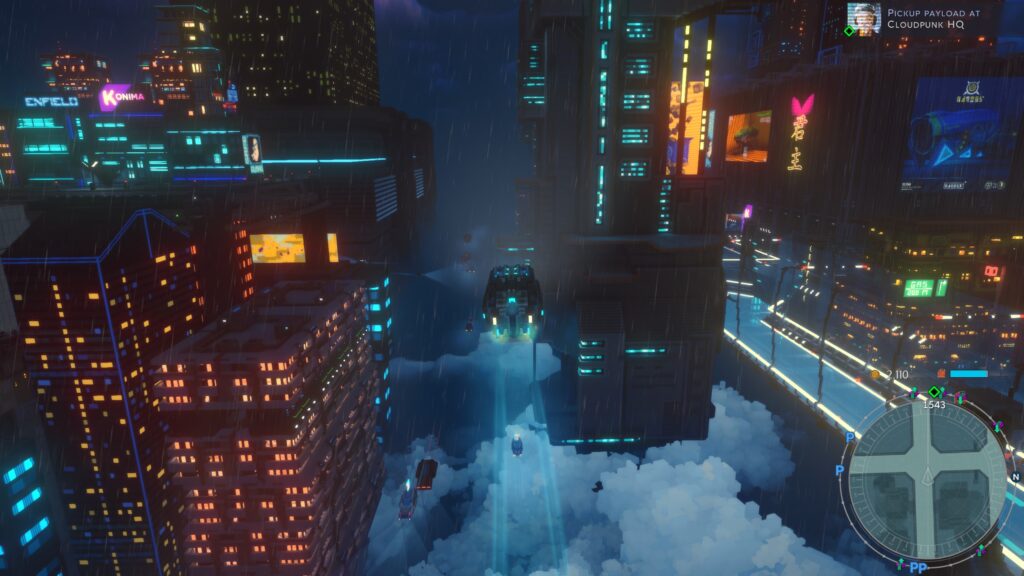
Playing a dystopian cyberpunk game during a global pandemic isn’t the most sensible thing to do — the real world is dystopian enough. So why escape to a dying, neon-lit futuristic city where it always rains and play Rania, a delivery driver working her first shift? In December 2020, the outcome of the pandemic was still frighteningly uncertain, and lockdowns had radically disrupted the routines of everyday life. Yet even then, people found ways to make life feel normal: cooking, watching movies, going for walks, calling friends. On paper, Cloudpunk didn’t seem like much of an escape. Why voluntarily spend my time in a collapsing cyberpunk city when the real world already felt so precarious — and why did I enjoy it so much?
Cloudpunk is, in fact, a glorified walking/flying-a-hovercar simulator wrapped in a bittersweet story that seems, at first, perfectly at home in the cyberpunk genre. Most of the characters you meet are broken in their own way, underscoring the melancholy of Nivalis. And yet the city itself is anything but bleak to look at. It is beautiful and breathtaking. I found myself wandering — or rather, hovering — around simply to take in its gorgeous vistas and bustling squares. The constant rain, the flow of traffic, the neon lights and hovering billboards create an oddly calming and relaxing atmosphere, even though I wouldn’t want to live in Nivalis. There is an oppressive desperation in the air, a sense of the futility of hoping for a better future that, at the time, felt uncomfortably familiar. And yet, dystopia at its core or not, my time in Nivalis — the story covers a single night (two, counting the DLC), though it took me considerably longer than that to actually finish it — was among the most enjoyable I’d spent in a game in a long time.
A Comfortable Dystopia
Just like Road 96, Cloudpunk produces a striking affective dissonance — but in almost the opposite direction. Nivalis is simultaneously beautiful but depressing, exciting but uneventful, enormous but intimate, dystopian but comforting, decaying but full of life. Almost everything in the narrative tells you that the city is going to crumble, disintegrate, and eventually fall into the ocean, yet the game rarely feels apocalyptic. I think of it as a kind of “comfortable dystopia.” Unlike many games built around impending catastrophe, Cloudpunk generates curiously little urgency. Yes, Nivalis is dying. The AI that runs the city’s infrastructure is failing, and eventually the consequences will be devastating — but it is happening slowly. Citizens still go to work. Food stalls remain open. Ads continue to play. Taxi services operate. People complain about rent rather than the end of civilization. Even Rania, working her first night as a Cloudpunk delivery driver, seems to have all the time in the world to make her deliveries. Her main concern is simply making it through the night, even though most drivers don’t survive their first shift.
The result is a strange normalization of catastrophe, something that feels surprisingly akin to living with climate change. Everyone knows that something is fundamentally wrong, yet daily routines continue. The apocalypse is narratively present, but affectively distant. Life goes on because there is still work to do, food to sell, packages to deliver, and rent to pay. Climate change offers a real-world parallel: its consequences can be enormous and frightening, yet they unfold slowly enough to coexist with everyday life. We still go to work, meet friends, buy groceries, make plans, and worry about ordinary things while knowing that something much larger is changing around us. Knowing the world is falling apart doesn’t mean you feel it falling apart every second of every day. Cloudpunk gets that feeling exactly right — you can fly past a crumbling district on your way to deliver someone’s lunch and not think twice about it. The city is still dying, but its inhabitants, and by extension the player, get to go about their day like it isn’t.
Learning the City
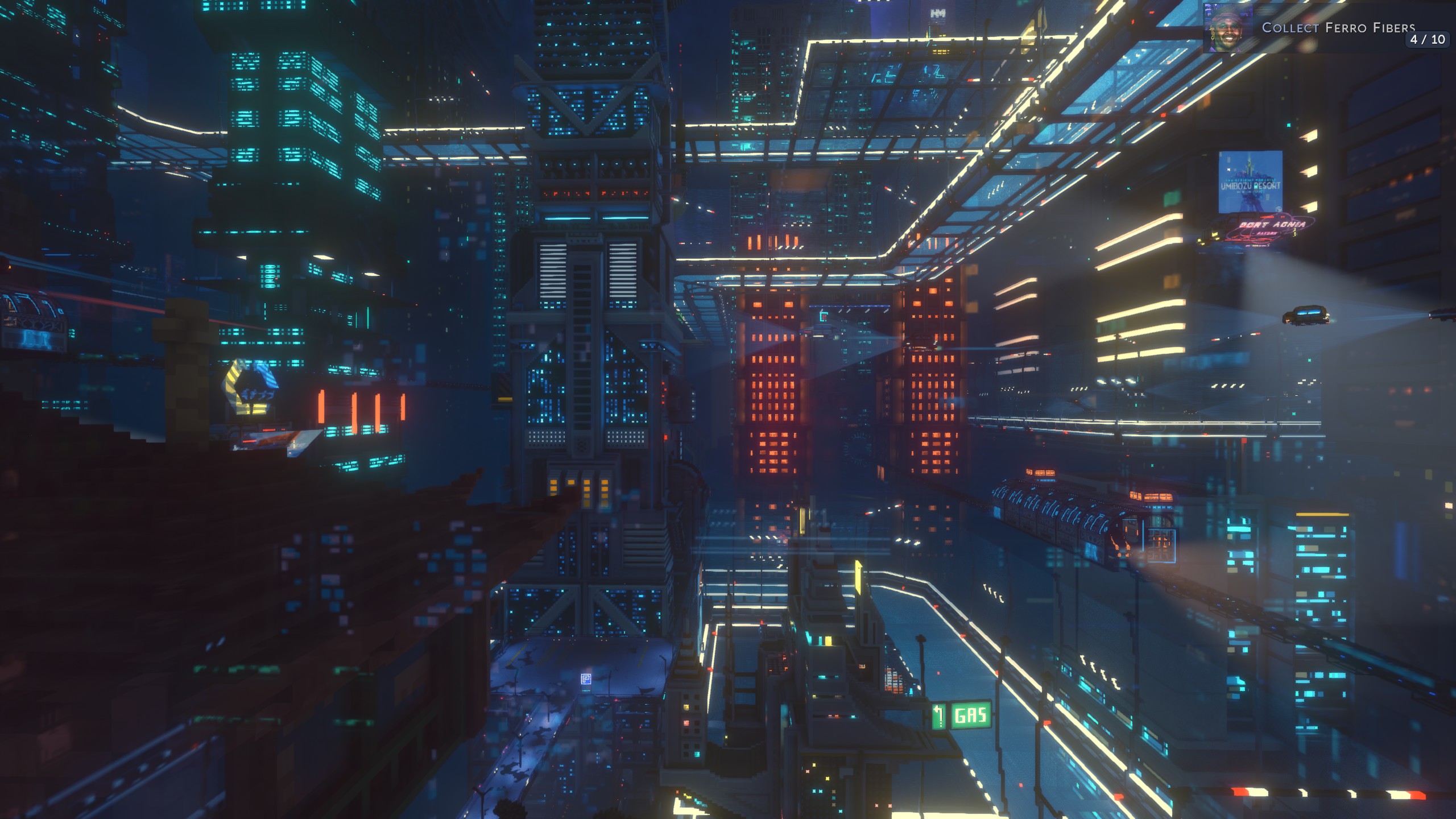
Much of Nivalis’s appeal comes from the way the city itself is constructed. It is a vast vertical metropolis built above the sea, with the privileged inhabitants living high above the clouds in the Spire while poorer parts of the population occupy the dense lower levels such as the Marrow. The city’s social hierarchy is therefore literally built into its vertical architecture. It’s the visual style layered on top of it, though, that makes Nivalis so appealing to spend time in. Voxel graphics, used instead of a photorealistic style, take the sharp edges off the dystopia and create an aesthetic distance. From above, the city becomes an immense landscape of light, rain, neon, and movement. You watch it stream past, structures disappearing into fog, until you slowly learn the visual identity of each neighborhood. That identity is closely tied to the character of each district: the Marrows and Ventz are darker, more constricted, and maze-like, with muted, toned-down colors that reinforce their sense of neglect and isolation, while residential and business areas tend to be brighter, more spacious, and more colorful. The style makes the city look visibly artificial, a reminder that you’re looking at a constructed representation — one that contributes directly to Cloudpunk‘s sense of a “comfortable dystopia.” Nivalis isn’t primarily designed to show you what a cyberpunk apocalypse looks like. Quite the contrary: it’s vibrant, and it wants you to feel what it’s like to actually live there. Its sheer contrast between light, colors, and shapes should make you feel insignificant, yet it invites you to look closer and explore.
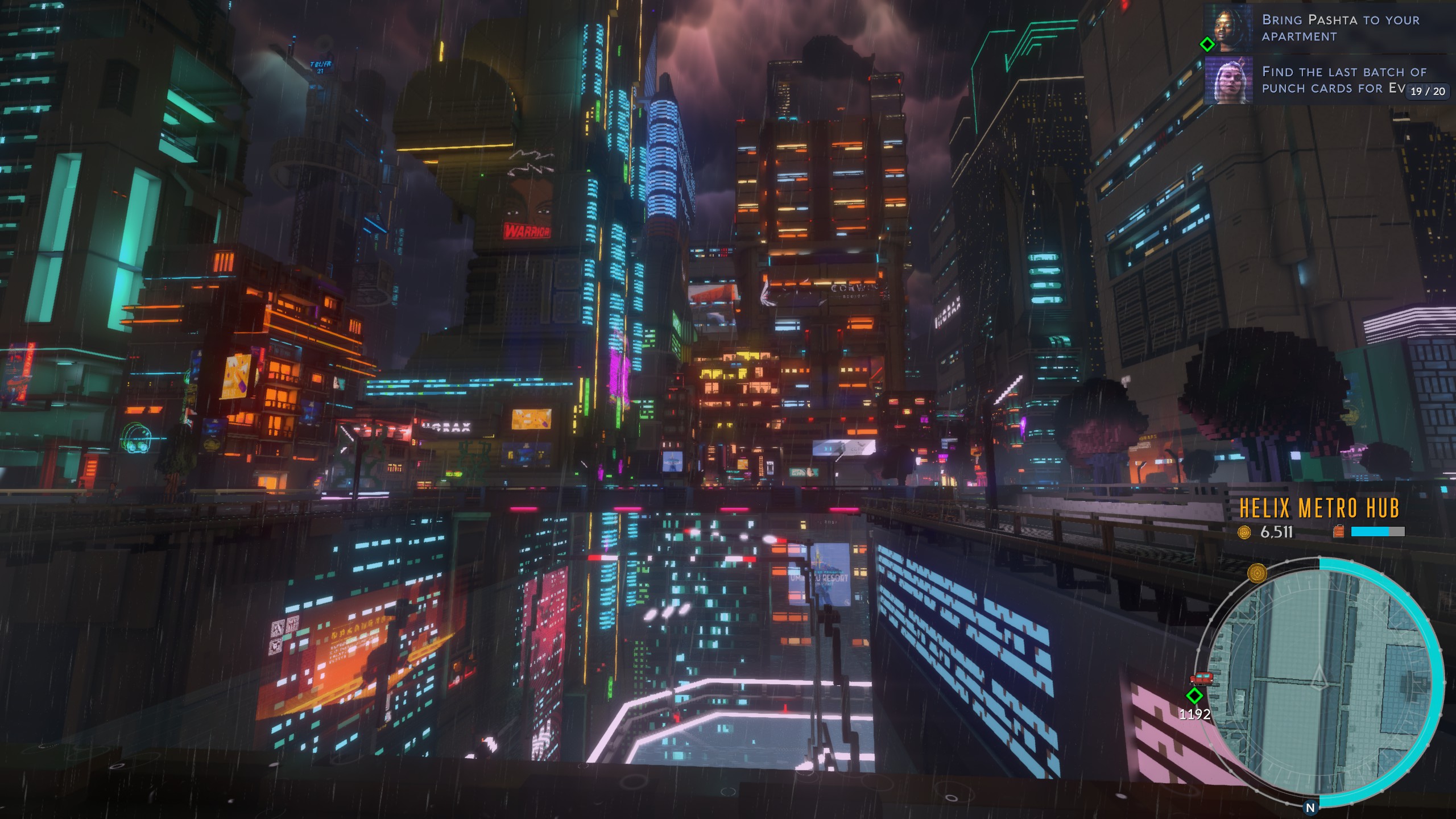
Driving — or rather, flying — your hovercar is the key game element, and it’s incredibly soothing. There is no pressure to deliver packages on time, even though “don’t be late” is technically the first rule of the job, and gliding through the traffic of Nivalis feels not unlike floating in water, creating a weightless and comfortable sensation. I ended up flying around the city simply for the sake of it. Nivalis is immense and visually overwhelming: giant skyscrapers, rain, neon, traffic, and a superb soundtrack that underscores the “chill out” vibe. The smooth movement and relaxed pace turn the city into something almost meditative: I could simply drift through its streets, taking in the scenery without having to accomplish anything. I was watching Nivalis collapse from behind the windshield, and instead of feeling threatened by that, I felt oddly sheltered — a digital equivalent of sitting inside a warm room while a storm rages outside.
This feeling is further enhanced by the repetitive nature of delivering packages for Cloudpunk. The routine is always the same: you pick up a package, fly to the destination, land at a parking lot, and walk to drop it off. It’s ritualistic. At first, Nivalis feels like a gigantic, undecipherable cyberpunk metropolis, but halfway through the game, its streets and districts start to become familiar. I know where I am going, recognize the places I pass, and begin to feel at home in the city. That’s a peculiar thing for a cyberpunk game to do — the genre usually runs on alienation and disconnection. Cloudpunk does almost the opposite: through repetition and routine, it gradually turns a strange city into a place I know — and eventually into something resembling an emotional home.
The soundscape reinforces that same sense of belonging. The pattering rain, the low-frequency mechanical whirring and magnetic hum of the hovercars, radio chatter, advertising, distant conversations, and a soft synthwave soundtrack blend into a continuous ambient texture. Nothing screams for attention. Even the soundtrack itself, which turns noticeably darker in the Marrows, Nivalis’s slums, never tips into tense or frightening — no musical cues telling me how to feel, no sudden shifts demanding a reaction, nothing that pulls me out of the rhythm of simply being in the city. Instead, all of it together gives Nivalis a sense of continuity and depth, making the city feel alive without making it feel threatening. It becomes less a soundtrack I actively listen to than a soundscape I move through.
Low Stakes, Real People
The emotional stakes are unusually low-key — even though the game keeps insisting they shouldn’t be. Instead of asking, “Can we save humanity?” Cloudpunk constantly asks, “Can Rania get through the night?” and reminds me more than once that most drivers don’t make it through their first shift, killed by either traffic accidents or the semi-illegal packages they carry. And yet nothing in the gameplay supports that claim. There is no combat, no boss fights, no enemies, and no real sense of physical danger. It’s another version of the dissonance running through the whole game: the fiction keeps insisting this night could kill her, while the mechanics barely allow for her to die at all. She can fall off a ledge and get reset, no penalty, no consequence, but she can’t have a fatal hovercar crash or die from a delivery gone wrong. Even her role in the larger plot follows the same pattern: she never sets out to save CORA, the AI keeping Nivalis alive; it just sort of happens, one delivery at a time. In contrast to the crumbling city around her, Rania’s own routine stays steady, which lets the game be contemplative rather than reactive. The narrative may be about a city approaching collapse, but the experience of playing it rarely makes me feel as though I am in danger.
The characters are another reason Cloudpunk works so well emotionally. Most of them aren’t larger-than-life heroes or villains but ordinary people navigating extraordinary circumstances with ordinary problems: missing pets, broken relationships, financial troubles, loneliness, and the desire to simply get through another day. Their concerns are often quite small compared with the monumental city surrounding them, and that contrast keeps the emotional focus grounded. Instead of making me worry about the fate of Nivalis as a whole, these encounters made me care about the people living in it. I found myself becoming genuinely invested in some of these characters, caring about their individual stories even though none of them could save the city. Two, in particular, have stayed with me ever since: Camus and Ava Jate.
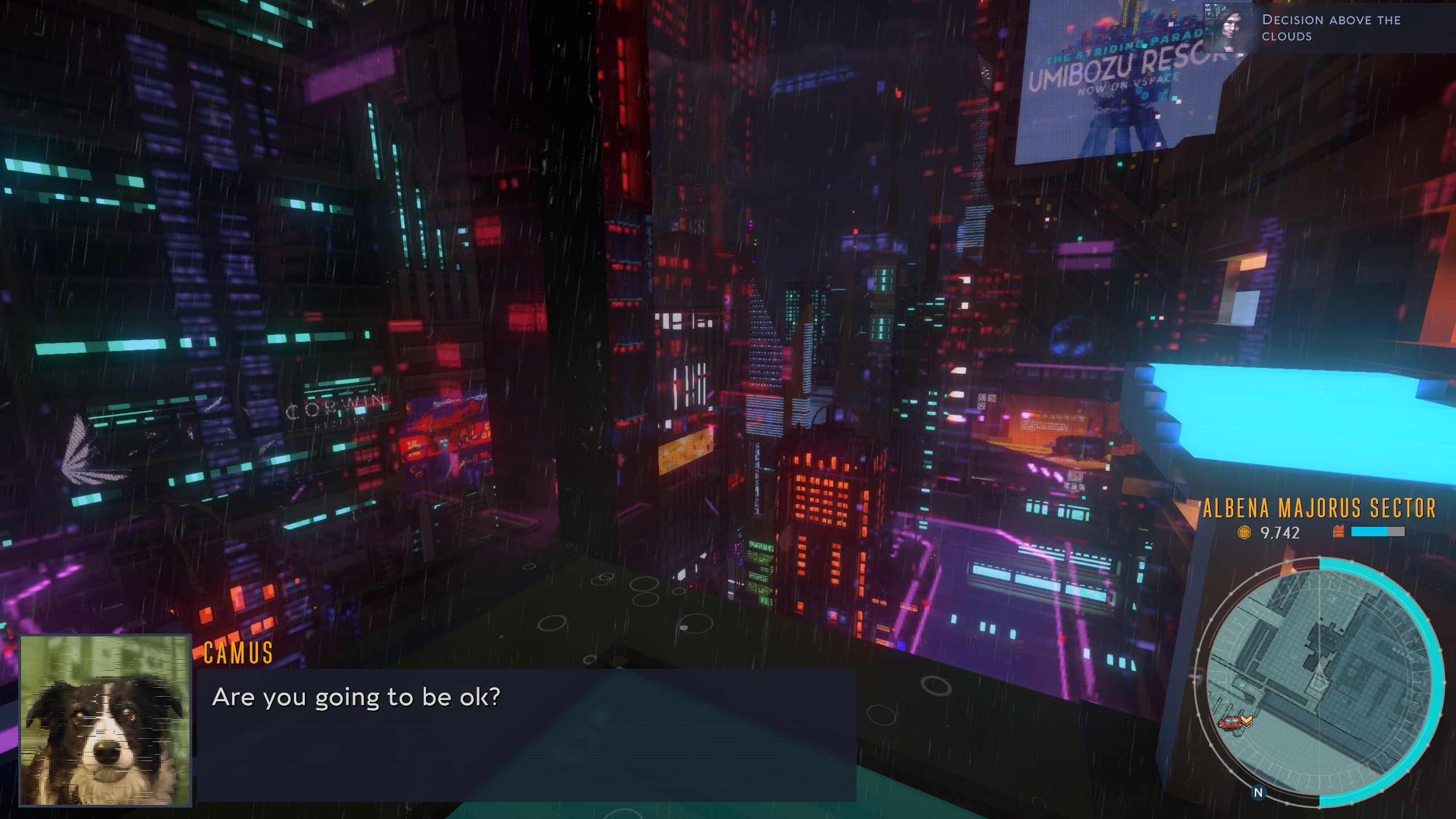
Camus wasn’t always a voice in Rania’s HOVA, her hovercar. He used to be her dog, a real, physical companion, until debt forced her to sell his body. His personality survived as an AI on a data drive, and with nowhere else to put him, she uploaded him into the HOVA. The name is probably not an accident — a dog who finds meaning in a world with no guarantee of one isn’t the kind of detail that happens by chance. I liked Camus from the very first moment he appeared. He is endlessly optimistic and almost childlike in the way he approaches the world, providing a striking contrast to the often cynical and worn-down inhabitants of Nivalis. While the human characters have been shaped by the hardships of the city, Camus seems largely untouched by its pervasive resignation. He doesn’t need to save the city or promise anyone a better future. He just wants to be part of it, which is a strange thing to say about a dog whose existence is itself a product of the same broken system he seems so unbothered by. More importantly, he becomes a pillar of support for Rania and an emotional counterweight to everything breaking down around her — arguably her most comforting relationship, maybe her most human one, even though he isn’t. Whatever situation they end up in, Camus stays open to the world, and that openness is contagious. Through him, Nivalis feels less like a dying dystopia and more like a place that is still worth experiencing.
Ava Jate appears in the DLC City of Ghosts, the darker and more tense continuation of Cloudpunk. Her encounter stayed with me, partly because of her markedly posh British accent and her infectious enthusiasm, but mostly because of the strange little “mission” she gives Rania. It isn’t another delivery. Instead, Ava asks Rania to run a few errands for her, which turn out to involve shopping. Not physically, of course — Ava stays in constant contact with Rania over the comm, enthusiastically accompanying her on every step of the trip, treating it like two girls shopping together, excitedly discussing what Rania should buy for her. The player is asked to find a necklace, a dress, and a pair of shoes. At first, I thought this was a huge time sink — Nivalis is still falling apart, and here I was shopping for someone. But the longer the mission went on, the more I realized the apparent waste of time was entirely by design. And then the game reveals what the shopping trip was really about: Ava isn’t shopping for herself at all. Everything is for Rania. She wants to take her on a date. Suddenly, what felt like an extravagant detour becomes something much more meaningful — the game has made me participate in an ordinary act of anticipation and intimacy. She isn’t interested in spending her remaining time contemplating the apocalypse. She wants to have fun, dress up, go on a date. Sometimes, even at the end of the world, people just want to go shopping with someone they like.
When the Comfort Cracks
City of Ghosts hits differently, and not just because it’s darker. To begin with, it adds a second playable character named Hayse, who is on the run from Morpho, an android determined to arrest him. Switching between him and Rania breaks the routine that made the original game feel so immersive: I found it more distracting than compelling. There’s also a passage late in the DLC that gets unexpectedly close to psychological horror, a register the base game never touches. Nivalis is still the same, but what actually changes is my relationship to it. In the original game, danger sits in the background: you deliver packages, drive through the rain, and slowly feel at home there, even while everything hints that the city won’t last. City of Ghosts no longer keeps that lingering danger at a distance. Hayse is actively hunted, Rania’s second shift becomes riskier, and the story keeps disrupting that sense of continuity by moving between two characters with very different personalities and relationships to Nivalis. For Hayse, the situation is precarious and increasingly self-destructive, while Rania’s story remains rooted in the familiar routines of her work. The comfortable dystopia of the base game gives way to something closer to a threatening one, and that shift in the game’s affective register changes the way I experience Nivalis.
Some of the DLC’s most memorable moments, though, are the ones that feel most like the original game — and two of them capture that feeling in almost opposite ways. Ava’s shopping trip stands out as an exception — mundane, funny, and entirely unnecessary with everything else going down the drain. It feels as if it wandered in straight from the original game: people simply carrying on with their lives. The unlicensed jazz encounter, by contrast, has far more serious consequences. Hayse gets caught in a police raid on a jazz bar because playing or listening to jazz without a license is, technically, a crime in Nivalis. The way out is even more absurd than the setup: the player has to handpick three of the musicians, whose improvised performance the system’s algorithm no longer recognizes as jazz, leaving no grounds for the raid. It’s ridiculous, and that’s exactly the point. Even something as harmless as music has been regulated and commodified to the point where the only way to keep playing it is to deliberately make it something else. Despite how different they are, both moments capture the same stubborn persistence of everyday life: Nivalis may be coming apart at the seams, but people keep shopping, making music, working, and finding small pleasures anyway, sometimes at real risk to themselves. The absurdity makes that dystopia paradoxically manageable: it doesn’t stop people from living; it simply becomes the backdrop to their everyday lives.
Nivalis, Revisited
There’s also a personal reason City of Ghosts felt different when I played it in February 2025 — one that has nothing to do with the game itself: I was no longer playing Cloudpunk in the middle of a pandemic. When I first visited Nivalis in December 2020, the future felt genuinely unpredictable, lockdowns had disrupted everyday life, and finding small sources of comfort and pleasure had become unusually important. Cloudpunk gave me a place I could simply inhabit. I could fly through the rain, marvel at the city and its soundscape, follow my routines, and find comfort in a world where catastrophe existed without demanding my constant attention. Five years later, that specific need was no longer there. The pandemic had receded into the background, and with it the distinct affective conditions that had made Nivalis feel so comforting to me in the first place. I didn’t feel the same desire to escape into the city. Yet that didn’t make my encounters in Nivalis — Ava’s shopping trip, the jazz bar, all of it — any less affecting. In some ways, it made me notice them differently. Ava’s insistence on shopping and asking Rania out, the musicians improvising their way out of being recognized as jazz — neither moment gave me the same sense of refuge I had found in Nivalis in 2020. Instead, both moments reminded me of something I had already experienced back then: even when the world around us feels uncertain, people still find ways to make room for anticipation, connection, and a little bit of absurdity.
By the end, I realized that I had stopped caring quite so much about whether CORA, the AI running Nivalis, could be saved. The city’s future had become almost secondary to the lives unfolding within it. I cared about Camus. I cared about Ava’s excitement about asking Rania out. I cared about the familiar streets, districts, and neighborhoods I had flown through time and again. The game had gradually shifted my attention from a dying city to the people who continued to live in it. Perhaps that is ultimately why Cloudpunk never felt like the dystopia its premise suggested: it doesn’t ask us to save the world. It asks us to inhabit it — to find companionship, routine, and small moments of joy, even when we know that it won’t last. And it feels so damn good.