
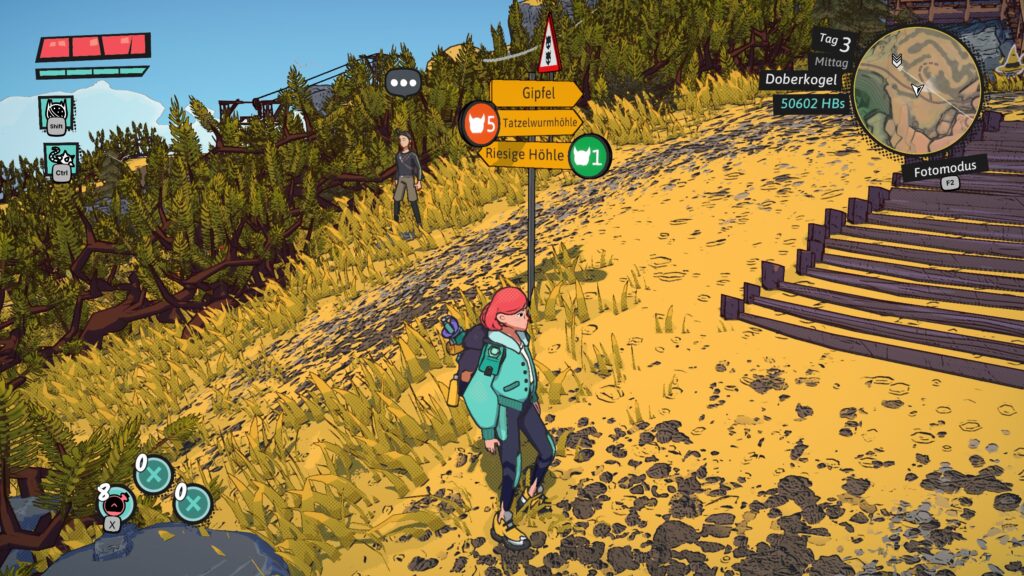
A friend of mine gifted me Dungeons of Hinterberg for my birthday because he thought it was a game I should play. I was expecting a fairly straightforward fantasy RPG set in the Alps, with bosses inspired by Austrian folklore — at least, that was how he described it to me. I was intrigued nonetheless. I wanted to fight the Krampus and the Tatzelwurm, and I was curious to see what an Austrian indie studio would make of the country’s many cultural clichés. It is not every day that you play a game made in Austria that is also set in Austria. What I got was very different from what I expected — and much more interesting. Dungeons of Hinterberg is not simply about Luisa, a burned-out lawyer trainee from Vienna who heads to the Alpine village of Hinterberg for a vacation. Somehow, it actually feels like a vacation. But why?
Hinterberg is a picturesque village heavily inspired by places like Hallstatt, Bad Ischl, and Gmunden, and Luisa has come here to escape her ordinary life. Even the name seems appropriate: Hinterberg evokes the idea of a place tucked away behind the mountains, remote and secluded from everyday life. That is exactly what the village was before magical dungeons appeared three years ago. Since then, adventurers have been flocking to Hinterberg, hoping to clear all 25 dungeons and turning the sleepy mountain village into a thriving tourist destination. The game has all the makings of a fantasy RPG: there are monsters to slay, puzzles to solve, loot to collect, and gear to upgrade. But it’s just as much about everything you do between the dungeons: hiking in the mountains, sightseeing, having a drink at the local “après-slay” bar, going to the spa, watching a movie, or sitting somewhere and enjoying the view. You don’t have to rush from one dungeon to the next. You don’t even have to enter a dungeon at all. It sounds like a vacation. More importantly, it feels like one.
Luisa’s arrival in Hinterberg is anything but idyllic. She gets a crash course in adventuring from the tourist guide Klaus, who accompanies her into her first, supposedly beginner-friendly dungeon. Strange earthquakes and other unexplained phenomena have recently begun affecting the village, and one occurs while Luisa is inside the dungeon. Separated from Klaus, she has to fight her way to the exit alone. By the time she gets back to Hinterberg, Luisa has had enough. She decides that adventuring is not for her and plans to leave for Vienna the next morning. But she still has to spend one night in the village. So why not have a drink at the Krampus Bar? The bar is an affectionate caricature of Alpine après-ski culture, complete with the atmosphere and clichés one would expect from a ski resort nightlife hotspot. There, she meets a collection of journalists, influencers, celebrities, and fellow adventurers, who persuade her to give adventuring another chance: they offer her exactly what everyday life has denied her — a sense of low-stakes camaraderie and an invitation to engage with the world on her own terms, rather than living up to external demands. From this point onward, the game settles into a remarkably gentle rhythm.
The Rhythm of a Vacation
Each day begins with breakfast, where the B&B owner asks Luisa where she’d like to go — the mountain, the forest, the glacier, or the swamp, each with several dungeons of its own. The trip to your destination is unhurried and deliberate, almost an event in itself. If you decide to head for the mountain, for example, you take the cable car to the top; getting to the forest requires a bus ride. You have time to take in the view and enjoy the feeling of going somewhere. Once Luisa arrives at her chosen destination around noon, she can either enter a dungeon or explore the area, marvel at the scenery, and spend the afternoon doing essentially nothing. Here Dungeons of Hinterberg breaks with the typical progression-oriented RPG, which usually points the player toward the next quest or dungeon: the game repeatedly returns you to the present moment. The question becomes less “What do I need to accomplish?” and more “What do I feel like doing this afternoon?” In the evening, Luisa returns to Hinterberg, where she can go shopping, socialize with other adventurers and villagers, have a drink, visit the cinema or spa, or spend some time by herself. Then she goes to bed, and the next day begins.
It is an exceptionally simple structure, but it is also the foundation of what makes Dungeons of Hinterberg feel so much like a vacation. That doesn’t mean every moment is relaxing. The dungeons can be exciting and provide significant stimulation: combat, puzzles, and movement. Boss fights like the Tatzelwurm, the Windsbraut, or the Basilisk are truly challenging. Some puzzles require serious thinking. The glacier dungeons, where you snowboard down slopes at neckbreaking speed, are exhilarating. But once a dungeon is over, the game intentionally eases you back into its slower rhythm. In fact, even when a dungeon does start to feel like too much, the game gives you a way out. You can call Klaus at any point and have him bail Luisa out, no questions asked. The game doesn’t treat quitting as failure; it simply lets you leave. Rather than sustaining a high level of intensity, Dungeons of Hinterberg continually builds and releases tension. The result is a rhythm that feels less like the relentless progression of a typical game and more like the ebb and flow of an actual day on vacation: some excitement, some downtime, and enough space in between to unwind. Relaxation, here, isn’t the absence of intensity — it emerges through the controlled alternation of intensity and release. The game does not merely represent a vacation; it builds leisure into the way you play.
There are 25 dungeons in Hinterberg, and nothing stopping you from completing them in roughly 25 days. But you can easily take your time and spend more than 60 days in the village, as I did. It isn’t required to enter a dungeon every day. You can ignore the dungeons, wander around and explore, look at the landscape, or spend an afternoon somewhere without having to accomplish anything — the game leaves room for that too. The same applies back in Hinterberg: going to the spa, watching a movie, or socializing with fellow slayers or locals doesn’t have to serve a larger objective. Actually, seemingly doing nothing “productive,” like chilling at a mountain lake or soaking in the spa, is rewarded by a stat increase. The game literally rewards you for not accomplishing anything. Sam, a popular “pro slayer,” once offered to sit with me on a tree log in the swamp for an entire afternoon, just talking.
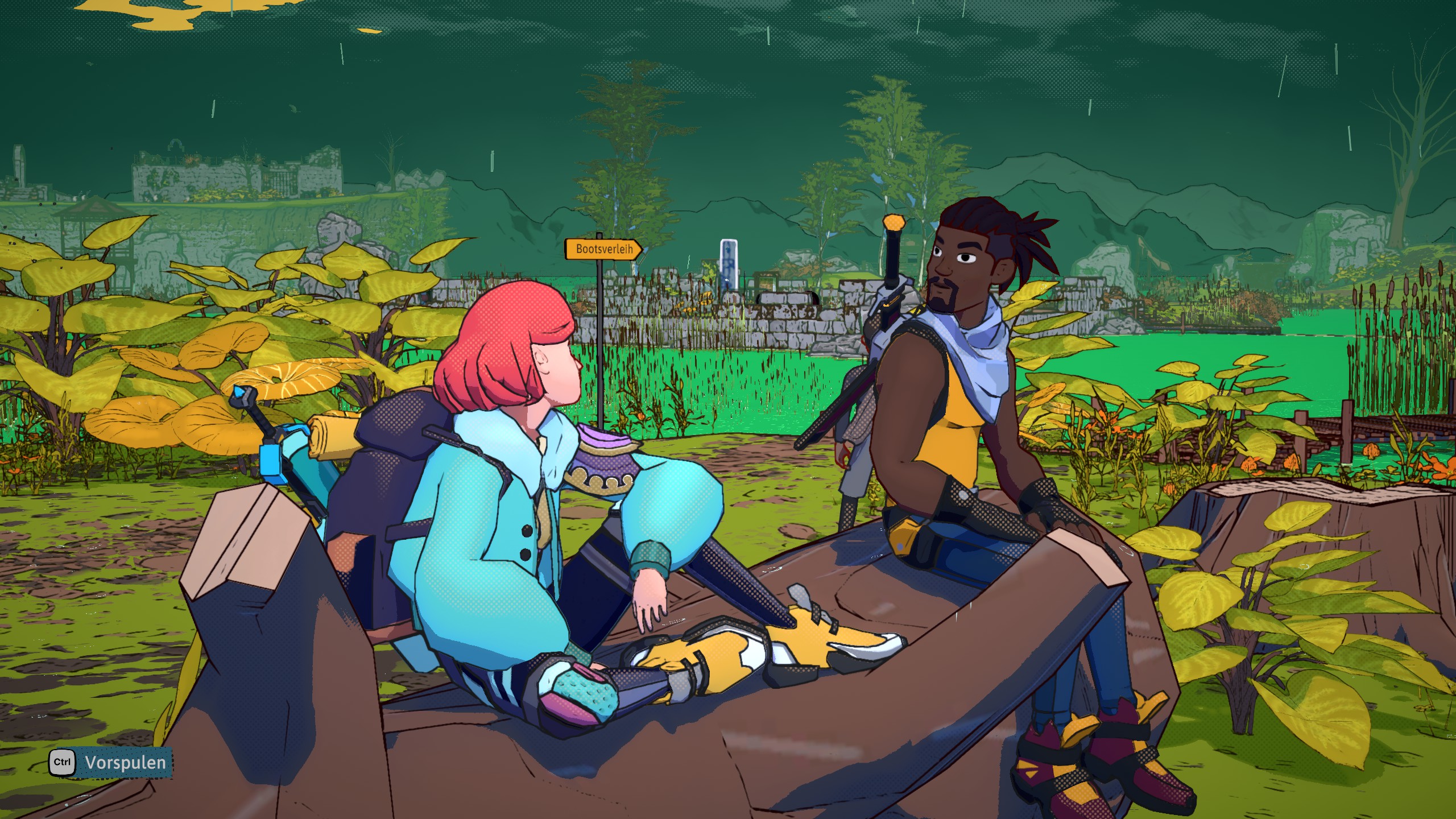
The significance becomes clearer when we consider how games usually structure the player’s time. Much of game design is built around the expectation that the player should always be doing something: the next quest, the next upgrade, the next dungeon, the next collectible. These systems give our time in the game a specific direction. We are expected to move forward, to make progress, and to turn the time we spend playing into something productive. Dungeons of Hinterberg repeatedly tells us that we don’t have to. It does not eliminate progression so much as decenter it, allowing the player to decide what to do and when to do it. Instead of constantly being pulled toward the next objective, we are free to linger. Things that might feel like downtime or wasted time in another game become legitimate ways to play.
The connection to Luisa’s burnout is particularly striking. She arrives in Hinterberg exhausted by her life as a lawyer trainee, but her burnout isn’t simply the result of having too much work. She has become accustomed to always accomplishing something. If the game responded to that by making her grind through 25 increasingly difficult dungeons, the irony would be obvious: you’re burned out, so here’s another job. Instead, Hinterberg offers her a way to temporarily step outside that logic — and asks the player to do the same. A player accustomed to RPG conventions may look at the map and think: Which dungeon should I clear next? Hinterberg offers another possibility: You don’t have to. That makes the game’s treatment of burnout mechanical rather than merely narrative. In most games, doing nothing is simply the absence of gameplay. Here, doing nothing can become an intentional choice. Luisa has to learn that not every moment needs to be productive; the player has to learn that not every available activity needs to be completed. Either way, it’s the same lesson. The game creates an affective alignment between character and player: Luisa’s vacation is not just something we watch her experience. We are asked to practice it alongside her.
Adventure as Leisure
Dungeons of Hinterberg doesn’t make us feel like we are on vacation just by showing us spectacular mountains, a charming village, forests, lakes, and glaciers. Its vibrant, cel-shaded, comic-book art style reinforces the impression that this is an inviting place you might actually want to visit. More importantly, the game turns the dungeons themselves into tourist attractions. Unlike in most fantasy games, you aren’t setting out to defeat an ancient evil or save the world. You are a burned-out lawyer trainee on vacation, participating in the “Dungeon Challenge” for recreation and personal fulfillment. This is one of the game’s funniest and most effective inversions. Something traditionally associated with danger, hardship, and heroic achievement has become a leisure activity. The dungeons are presented visually and structurally like outdoor sports destinations, complete with zip lines, snowboarding, and mine carts. Clearing a dungeon feels mechanically similar to going on a challenging hike, but with monsters, if you will. Slaying monsters is given roughly the same cultural status that a real-world ski resort town might give white-water rafting or a day on the slopes: an exciting, packaged afternoon activity before you head back to town for a drink at the Krampus Bar.
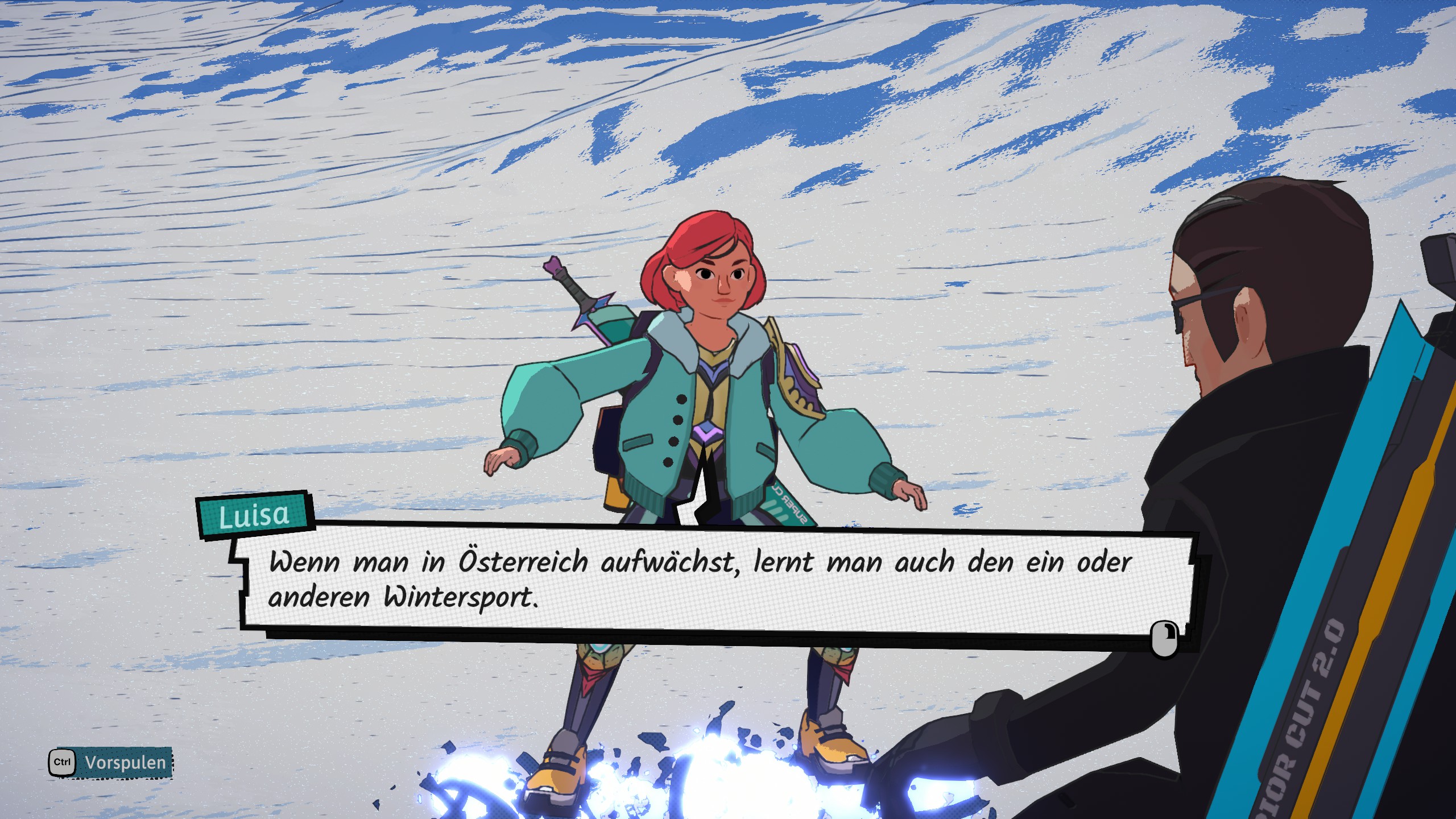
The dungeons themselves support this approach. They combine combat against monsters inspired by Alpine mythology with environmental puzzles, generally providing enough challenge to be engaging without becoming stressful. The glacier dungeons show this particularly well. Instead of fighting your way through another series of rooms, Luisa gets to snowboard down slopes and slide through the landscape at ridiculous speeds. It is exciting, but it feels less like overcoming an obstacle than going on a theme-park ride. It even reminded me of Ski or Die from the 1990s. The difference is that here, the point isn’t really to win a competition — it is to enjoy the ride. There was, however, one notable exception for me: the Waterlily River dungeon, which switches from the usual third-person perspective to an isometric view. I found the controls awkward and imprecise, and at one point a carefully timed jump repeatedly failed to register, no matter whether I used a keyboard and mouse or a gamepad. I fell into the water over and over again, each time having to redo a considerable portion of the dungeon. After countless attempts, I was frustrated and honestly ready to rage quit. I could have called Klaus and ended it right there. I chalked it up to poor dungeon design and even considered abandoning the game altogether, but felt I owed Dungeons of Hinterberg enough to keep going. That experience is interesting precisely because it broke the affective balance the rest of the game had established so well. A little challenge is fine, but here the experience tipped into frustration — briefly turning the vacation into work. For the most part, however, the dungeons understand exactly what kind of game Dungeons of Hinterberg wants to be. They provide enough friction to make the vacation interesting, but not enough to make it exhausting.
In a sense, the dungeons are affective machines. They are designed to produce a specific kind of adventure — excitement, discovery, challenge, and ultimately accomplishment — while keeping the stakes low enough to remain recreational. That makes the game’s central plot twist especially interesting, because it turns the idea of engineered adventure into something literal. Mayor Karin Wagner, who bears some resemblance to a well-known Austrian politician, discovers that once a single adventurer completes all 25 dungeons, they will disappear — which would bring Hinterberg’s tourism boom to an end. Her solution is wonderfully absurd: hide one of the real dungeons and create a fake one in its place. Playing through it, something feels subtly off. It is never stated outright, but as Luisa moves through the fake dungeon, the puzzles don’t quite click into place the way they do elsewhere, the different elements don’t fully add up, and the sense of discovery seems strangely staged. It resembles a real dungeon closely enough to be convincing, without producing the same feeling.
The fake dungeon isn’t just a plot device uncovered by Luisa. It becomes a kind of mise en abyme of what Dungeons of Hinterberg itself is doing: manufacturing the feeling of adventure and escape for a player who is never in any real danger. Mayor Wagner is trying to reproduce the output of an affective machine: she wants a fake dungeon to generate the same thrill, novelty, and satisfaction as a real one and comes up slightly short, which is exactly why the player feels the difference. The game is doing something similar on a larger scale. It constructs mountains to explore, dungeons to clear, and activities to enjoy — all to give a perfectly safe player a genuine sense of adventure and escape. The difference is that Dungeons of Hinterberg succeeds where Karin’s counterfeit dungeon fails. The fake dungeon mimics the structure of an adventure without quite delivering its affective payoff. The plot twist becomes a quiet moment of self-awareness. The game spends much of its time convincing us that we are on vacation, and the fake dungeon reminds us that this feeling, however real it may become while playing, is something the game has carefully constructed. The difference between the real and fake dungeon is ultimately what they make us feel.
Luisa eventually uncovers the deception, leading to the game’s final confrontation. This is where the game’s tourism satire connects back to its treatment of vacation. What Hinterberg is really selling goes beyond mountains, dungeons, or Alpine culture — it’s a specific way of feeling: the sense of having escaped everyday life and entered somewhere exciting, beautiful, and different. Dungeons of Hinterberg is doing something remarkably similar to the player. Luisa’s vacation isn’t something we passively watch — the game hands us the same conditions and lets us experience a version of it ourselves.
You Don’t Have To
Ultimately, though, the game’s strongest quality may have little to do with its satire. It is the feeling of having nowhere else you need to be. Hinterberg is not a world that constantly demands something from you. It does not need to be saved every morning. There is no looming apocalypse. There is no endless stream of urgent quests. There is no expectation that every available activity should be completed immediately. Instead, the game creates a rhythm. Go somewhere. Explore. Do a dungeon if you feel like it. Come home. Have a drink. Talk to somebody. Go to the spa. Watch a movie. Sleep. Tomorrow, do it again.
The dungeons give the game enough structure and challenge to provide moments of intensity, but the spaces between them are just as important. They create room for the player to breathe. And this is where Luisa’s burnout becomes more than a convenient character motivation. Her vacation is not about becoming more productive, finding a new career, or overcoming herself. Her vacation begins as an escape. Over time, though, she invests in the place and its people and finds herself becoming a seasoned adventurer almost in spite of herself. But that transformation happens on Hinterberg’s terms: gradually, without pressure, alongside the hiking and the drinks and the afternoons spent doing nothing. She doesn’t have to arrive with a plan for who she will become. The game lets that change emerge from the time she spends there.
Maybe the answer to exhaustion isn’t another goal — it’s having somewhere you’re allowed to stay for a while. Hinterberg does not feel like a place that needs to be conquered — it feels like somewhere you are staying. And that may be the true magic of Dungeons of Hinterberg: not the dungeons, the monsters, or even the spectacular scenery, but the way the game makes time itself feel different. It gives you something to do and reasons to keep going — but also time to stop, look around, do nothing at all, and, perhaps most importantly, permission not to accomplish anything.